
Ask most business owners whether their commercial property and general liability policies cover their goods, and they will say yes without hesitation. It’s a reasonable assumption. You pay premiums, you carry a policy, and your policy protects your goods. That assumption rarely holds up once you test it against where coverage starts and where it stops after a shipment leaves your hands.
Commercial property and general liability coverage assumes a business keeps its goods in one place. A shipment breaks that model apart into a sequence of handoffs, and standard coverage never follows a shipment through all of them. The disconnect shows up most often in three specific moments, where your business can be financially responsible for goods it no longer insures.
Moment 1: When Goods Leave the Facility
Standard commercial property coverage, whether it’s part of a business owner’s policy or a commercial package, ties to a fixed location: your warehouse, your storefront, your distribution center. Insurers price and issue the policy on that premise. The instant a shipment leaves that address, it leaves the geography the policy protects.
This is not a flaw in your policy. Rather, it’s the boundary the policy has always had. As the Insurance Information Institute’s guidance on inland marine insurance explains, inland marine coverage protects products and materials while they move over land by truck or train, or while a third party holds them temporarily. A standard property policy does not provide that protection. Collisions and cargo theft cause most inland marine losses once goods are on the move, and neither happens at a fixed location your property policy recognizes. Motor truck cargo coverage, one of the specialized categories under the inland marine umbrella, exists for exactly this reason. Standard property protection stops at the loading dock, and freight needs a policy that keeps up once the truck pulls away.
Moment 2: The Carrier-to-Final-Mile Handoff
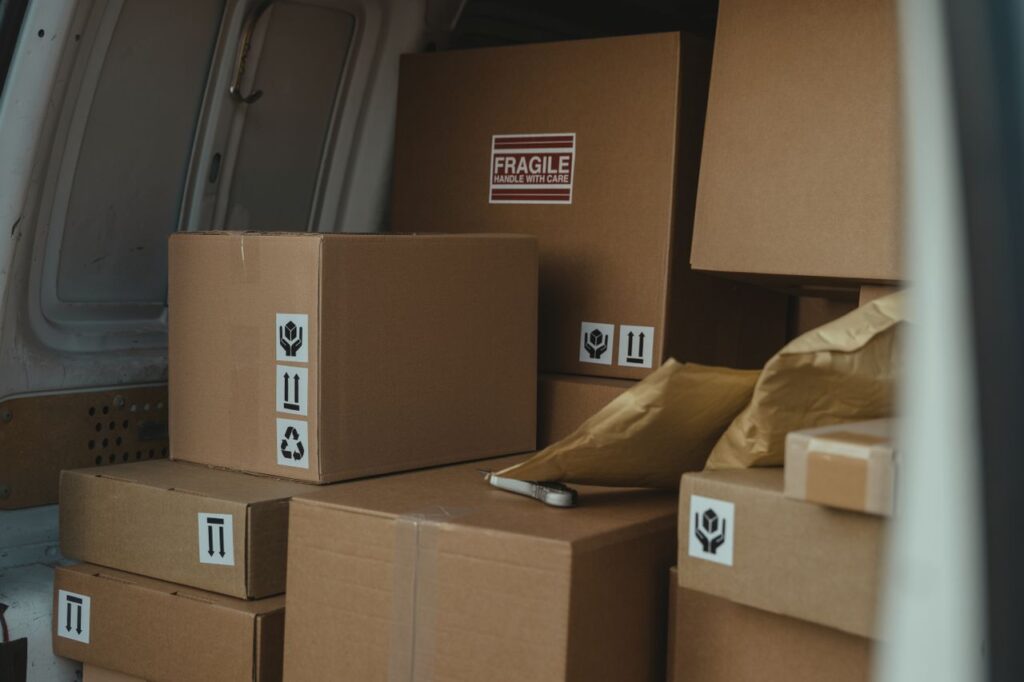
A shipment rarely travels start to finish with one carrier. Freight often moves through a long-haul carrier and then transfers to a regional or final-mile courier for the last leg of delivery. That handoff creates a second, quieter version of the same problem.
Your general liability policy centers on your own operations and your own premises. The III’s overview of commercial general liability insurance describes coverage that responds to incidents tied to your business’s operations, not to the actions of a carrier your business no longer physically controls. When a shipment changes hands between carriers, you’re often still financially responsible for that freight, but the coverage tied to your location and your operations has nothing left to attach to. Commercial auto insurance covers the vehicles your business owns and the drivers who operate them. Once your shipment is in a carrier’s truck, that’s not your vehicle, and your commercial auto policy has nothing to attach to either.
Moment 3: Delivery Confirmed, Return Window Still Open
The third moment is the one businesses examine least. A carrier scans a package as delivered, and most operations treat that scan as the end of the transaction. Delivered is not the same as final, though. Return, exchange, and recall windows keep plenty of shipments financially open long after the delivery confirmation.
During that window, a returned item is back in transit, subject to the same boundary as moment one. A defective or recalled item may involve your general liability policy’s response to a bodily injury or property damage claim, but that’s a different question from who bears the cost of the goods themselves. Few businesses map this window against their actual coverage. The interval between “delivered” and “return period closed” tends to go unexamined until something happens inside it. A 30-day return window on a high-value shipment means 30 days of exposure most businesses haven’t accounted for. That exposure runs in either direction: the shipment can go missing on its way back, or it can take damage while it sits waiting for inspection.
Coverage Built for the Moments In Between
These three moments share one cause: standard commercial insurance covers goods at rest, not goods in motion. Cabrella, a leading provider of shipping insurance and logistics risk management solutions, addresses exactly that interval. Cabrella is a technology-driven shipping insurance and logistics risk management platform, designed to give businesses enhanced control over shipping protection. Through dynamic pricing, robust API integrations, and multi-carrier compatibility, Cabrella extends protection across the handoffs.
For a business shipping regularly, that means coverage that follows the shipment itself. From out of the facility, between carriers, and through the window after delivery when a return is still possible. It’s not a replacement for your commercial property or general liability policy. It’s the coverage for the moments those policies never reach.
What to Do Next
Map your own shipment lifecycle against these three moments. Ask when your commercial property coverage stops applying once goods leave your facility. Also ask what happens, contractually and financially, at the exact point one carrier hands a shipment to another. Finally, ask how long your return window stays open, and what protects a shipment during it.
The SBA’s guidance on business insurance frames coverage as something to reassess as your business changes. A shipping-heavy business that hasn’t looked at its coverage since it started shipping at today’s volume is a strong candidate for reassessment.
Meslee works with businesses to map their actual shipment lifecycle against their current coverage and to close the specific intervals where that coverage runs out. Contact our team to talk through where your coverage protects your shipments and where it doesn’t.